
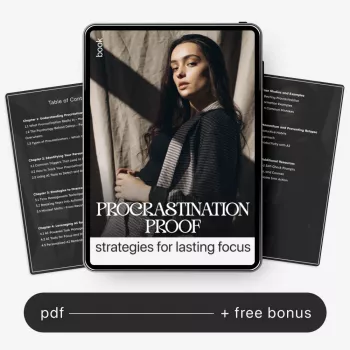
Procrastination rarely comes from laziness. More often, it’s a mix of unclear priorities, overwhelm, distractions, and tasks that feel too big to start. Finally Focused is a guided productivity workbook designed to help turn stalled intentions into consistent action using practical focus-building exercises, structured planning prompts, and time management tools that fit real life.
Instead of relying on a burst of motivation, the workbook nudges small behavior changes—so starting gets easier, follow-through gets more consistent, and planning becomes a tool you actually use (not another task to avoid). For additional context on why procrastination happens and what tends to help, see resources from the American Psychological Association and Harvard Business Review.
Finally Focused is a digital workbook that guides you through practical steps to reduce avoidance and rebuild focus in a way that works with busy schedules and imperfect weeks.
If planning tends to turn into overthinking, a guided format can help you move from “I should” to “Here’s what I’m doing next.” That shift—toward specific next actions—pairs well with “if-then” planning (implementation intentions), a research-backed way to make follow-through more automatic. You can learn more at the University of Pennsylvania (Implementation Intentions overview).
Finally Focused is especially useful when the issue isn’t knowing what to do—it’s doing it consistently.
The workbook focuses on two things procrastination disrupts: decision-making (what matters most?) and attention (can you stay with it long enough to finish?). Inside, you’ll find practical tools that reduce the friction of starting and make progress easier to repeat.
| Pattern | How it shows up | Tool to apply | Quick win |
|---|---|---|---|
| Overwhelm | Too many tasks, no clear starting point | Brain dump + top-3 priorities | Pick one 10-minute starter task |
| Perfectionism | Avoids starting unless conditions feel ideal | Minimum viable draft prompts | Set a “bad first version” timer |
| Time blindness | Underestimates how long tasks take | Time estimates + buffer planning | Add 25–50% padding to the schedule |
| Distraction loops | Frequent checking, multitasking, broken focus | Distraction plan + focus sessions | Put phone in another room for one session |
Systems survive when they’re realistic. Finally Focused leans on a weekly rhythm that stays helpful even when energy and motivation vary.
That final review is where procrastination often loses its grip. Instead of treating a rough week as failure, you treat it as data—then adjust the next week so the plan fits reality.
Turn deliverables into milestones, then assign each milestone a next action and a time block. If a task still feels “heavy,” shrink it until it becomes startable in under 10–15 minutes.
If you want a guided, practical structure for building focus and reducing procrastination, start here: Finally Focused: The Anti-Procrastination Workbook – Productivity Ebook & Focus-Building Guide with Time Management Tools. It works well alongside your calendar and to-do apps by adding a process for choosing priorities, defining next actions, and getting started.
To make your routine easier to stick with, consider pairing your planning sessions with small environmental supports. A cozy desk companion can make focus blocks feel less draining, like the Adorable Capybara Plush Pillow. And if walking breaks help reset your attention between deep-work sessions, comfortable shoes matter—check out Nike Women’s Fuchsia Slip-On Lace-Up Sneakers. For seasonal planning and budget-focused organization, there’s also Shop Smart, Save Big This Prime Day | What to Buy on Amazon Prime Day Guide | Digital Download Checklist & eBook.
Many people notice early wins within a few days—more clarity, less avoidance, and easier starts. Stronger habit changes typically show up after a few weeks of weekly planning paired with brief daily check-ins.
A planner or app stores tasks. A guided workbook helps you decide what matters today, break work into next actions, reduce avoidance triggers, and review what’s actually working so you can adjust quickly.
The workbook is designed for low-motivation days by emphasizing small, repeatable steps and short focus sessions. Prompts and trackers lower the barrier to starting, so progress can continue even when energy is limited.






Leave a comment