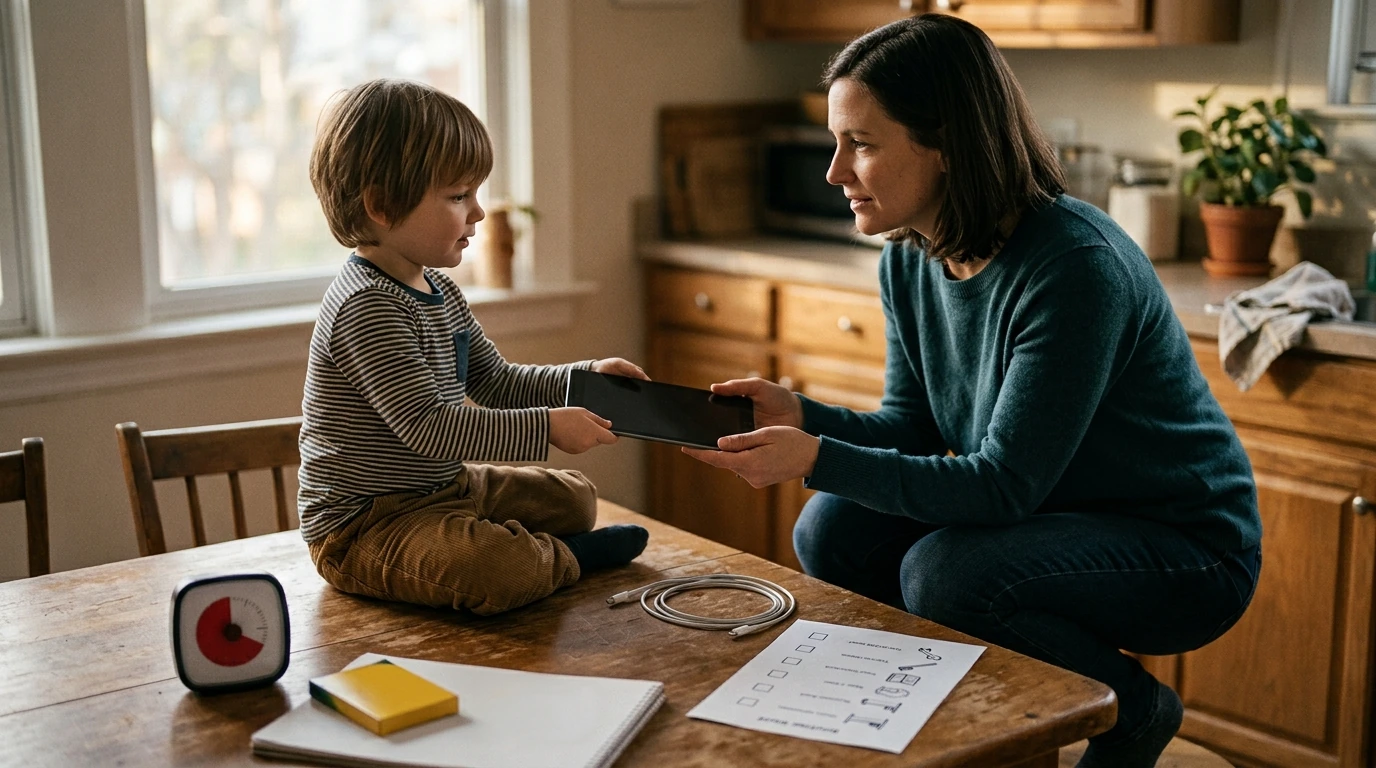
Screen-time limits don’t have to turn into daily power struggles. When kids feel surprised, rushed, or unheard, they push back harder—and parents end up repeating themselves, raising their voices, or negotiating in circles. The calmer path is a blend of connection (so your child feels understood) and structure (so your child knows what happens next). With a few repeatable scripts and predictable routines, screen-time conversations can become shorter, steadier, and far less emotional.
Most screen-time explosions aren’t really about the device—they’re about transitions and uncertainty. Common triggers include sudden cutoffs (“Time’s up!” with no warning), unclear rules (“Sometimes it’s fine, sometimes it’s not”), competing adult expectations, and screens becoming the main coping tool for boredom or stress. When the screen is the only reliable “calm-down button,” removing it can feel like losing control.
It helps to separate two goals: connection and structure. Connection sounds like, “You’re having fun and you don’t want to stop.” Structure sounds like, “Screens are done for today, and next is dinner.” You need both. Connection lowers defensiveness; structure reduces confusion.
Whenever possible, have proactive conversations when everyone is calm. Big rule changes mid-meltdown usually backfire. Also, treat “more time” requests as a cue to review the plan later—not a reason to argue in the moment.
The easiest screen-time ending is the one you set up at the beginning. State the plan in one sentence: what, how long, and what happens next (for example, “Twenty minutes of games, then dinner”). Keep it brief and repeatable.
Offer limited choices that keep the boundary intact: which app, what order to do tasks, or when to take a short break. Add visual time cues—timers, a five-minute warning, and a consistent end-of-screen routine (plug in, wash hands, pick the next activity).
| Situation | What to say | Why it helps |
|---|---|---|
| Starting screen time | “You can choose a show or a game for 20 minutes. When the timer rings, it’s time to put it away and start homework.” | Sets a clear boundary and a predictable next step |
| When a child asks for more | “I hear you want more time. The plan today is 20 minutes. You can earn more tomorrow by finishing your routine on time.” | Validates feelings without renegotiating in the moment |
| Before a transition | “In five minutes, screens go off. What’s your plan—pause here or finish this level?” | Gives control inside the limit and reduces surprise |
| If a rule is broken | “Screens are for the living room. Since it moved to the bedroom, screens are done for today. We’ll try again tomorrow.” | Natural consequence tied to the rule, not anger |
| When emotions spike | “You’re really disappointed. I’m staying close. Screens are still done. Let’s breathe and pick a reset.” | Co-regulates and keeps the boundary steady |
After the storm, do a short repair. Keep it simple: what happened, what to do next time, and how you’ll support the plan (timer, warning, or a clearer next step). If your child’s stress is high lately, remember that stress can intensify big reactions; the American Psychological Association’s overview of stress effects on children is a helpful perspective for understanding why small limits can feel huge.
Routines reduce constant asking because the answer becomes predictable. Anchor screens to specific parts of the day (after chores, after outdoor time, or weekends only). Create device-free zones like bedrooms and the dinner table, and consider limiting screens near bedtime to protect sleep. The CDC’s sleep guidelines can help you connect screen decisions to a concrete goal: better rest.
Plan “transition bridges” after screens—snack, movement, music, or a two-minute connection ritual (high-low of the day, a quick stretch together). Also model the rule: put your phone away during key moments and narrate your self-control (“I’m putting my phone down to be present”). For a bigger-picture plan, the American Academy of Pediatrics Family Media Plan is a strong, research-informed tool.
If you want a done-for-you option, try the How to Talk to Kids About Screen Time Without the Drama | Digital Parenting Guide | Printable eBook on Positive Communication & Healthy Screen Habits for printable scripts and routines you can keep on the fridge. For smoother transitions after screens, some families like having a cozy “reset” item nearby, such as the Adorable Capybara Plush Pillow. And if you’re anchoring screen time to movement (a great strategy for reducing constant asking), comfortable gear can help make “outside first” easier—like the Nike Women’s Fuchsia Slip-On Lace-Up Sneakers for quick, no-fuss outings.
Acknowledge the feeling, restate the boundary, and give one clear next step: “You’re disappointed. Screens are done. Please plug it in now.” Then follow through with a calm, predictable consequence tied to the rule—without debating or adding time.
Agree on 2–3 non-negotiables (like bedtime, device-free zones, and respectful behavior), decide consequences in advance, and use shared scripts so you sound aligned. Save rule tweaks for adult-only check-ins, not in front of the child.
Reduce gradually, anchor screens to routines, and add transition warnings plus a planned “after screen” activity. Expect some protest at first, and focus on consistency—predictable limits usually lower meltdowns over time.







Leave a comment