Lead From Anywhere and Make It Work: A Practical Guide to Remote Leadership With AI
Remote teams can move fast—or drift quietly. The difference usually comes down to clarity: clear expectations, consistent communication, and lightweight systems that make progress visible without requiring constant meetings. Add AI in the right places—summaries, checklists, and decision memos—and managers can increase speed and consistency without turning the workday into a nonstop video call.
Below is a practical approach to remote leadership that emphasizes routines you can keep, documentation your team will actually use, and safe AI workflows that support better judgment rather than replacing it.
What changes when leadership goes remote
Managing a distributed team isn’t just “the same job, but on Zoom.” The environment changes how information flows, how trust forms, and how culture is maintained.
- Work becomes documentation-first: decisions, context, and ownership need to live in writing, not hallway conversations. If it isn’t written down somewhere findable, it effectively didn’t happen for half the team.
- Trust shifts from visibility to outcomes: progress is measured by deliverables and quality signals, not online status. “I saw them working” gets replaced by “the work moved forward and met the bar.”
- Communication needs intentional cadence: fewer ad-hoc pings, more structured updates and predictable response windows so people can do deep work and still stay aligned.
- Culture becomes a product of rituals: onboarding, recognition, and feedback loops must be designed rather than assumed.
Core operating system: goals, roles, and decision clarity
Remote leadership essentials and AI support
| Need |
What good looks like |
AI can help by |
Manager check |
| Alignment |
Goals and priorities are visible and current |
Summarizing updates into a weekly priorities digest |
Can anyone explain top 3 priorities in 60 seconds? |
| Ownership |
Every task has one owner and a deadline |
Drafting task breakdowns and responsibility lists |
Are handoffs explicit and documented? |
| Speed |
Fewer meetings, faster decisions |
Creating decision memos and pros/cons comparisons |
Are decisions recorded with rationale? |
| Quality |
Consistent standards and review loops |
Generating checklists and test cases from requirements |
Are defects or rework trending down? |
| Inclusion |
Time zones and styles are respected |
Converting discussions into asynchronous briefs |
Is participation balanced across locations? |
Communication that scales: rhythms, channels, and expectations
Using AI for managerial leverage without losing trust
- Start with low-risk use cases: summarizing notes, drafting agendas, turning updates into a concise digest, generating checklists, or creating first drafts of decision memos.
- Keep humans in the loop: AI outputs are drafts. Managers remain accountable for accuracy, tone, and the actual decision—especially when consequences affect people.
- Create disclosure norms: if AI assists with performance feedback, policy language, or sensitive communication, set expectations about what’s reviewed and how confidentiality is protected.
- Protect data: avoid pasting confidential information into tools that aren’t approved. When in doubt, redact details or use company-safe solutions aligned with risk guidance like the NIST AI Risk Management Framework.
Performance and feedback in distributed teams
- Define what “good” looks like: concrete deliverables, quality standards, and observable behaviors tied to team goals. Ambiguity is where misalignment and bias grow.
- Run outcome-based 1:1s: focus on priorities, blockers, decision needs, and growth. Move pure status reporting into async updates so 1:1s can stay high-value.
- Give timely micro-feedback: short, specific notes after key events prevent surprises during formal reviews and reinforce what “great” looks like in practice. For additional guidance on feedback habits, see Google re:Work’s manager feedback guide.
- Document coaching plans: goals, supports, milestones, and follow-ups. Documentation should be consistent and respectful—written as if it could be read later by the employee and HR.
Leading across time zones and preventing burnout
- Set collaboration windows: define overlapping hours and protect deep work outside them. If overlap is limited, use it for decisions and relationship-building, not routine status.
- Use handoff practices: end-of-day updates, clear next steps, and tagged owners keep work moving across regions without late-night messages.
- Normalize boundaries: response-time expectations, no-meeting blocks, and rotation for after-hours coverage prevent quiet resentment and chronic fatigue.
- Watch for quiet overload: declining participation, delayed replies, and reduced quality can signal burnout or unclear priorities. Research and reporting from outlets like Harvard Business Review’s remote work coverage consistently highlights how clarity and boundaries protect performance over time.
A 30-day rollout plan for remote leadership with AI
Practical resources for modern managers
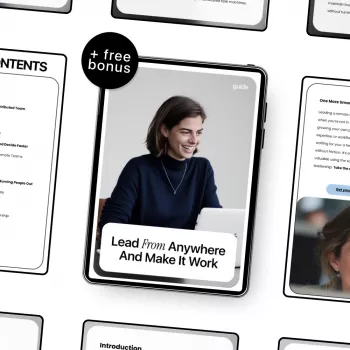
Templates and repeatable routines reduce reinvention and make it easier to onboard new managers or scale a growing team. For a ready-to-use playbook built around remote leadership habits and AI-assisted workflows, consider Lead From Anywhere and Make It Work | Practical Guide to Leadership in Remote Teams With AI for Modern Managers.
FAQ
How can AI help manage a remote team without replacing human judgment?
Use AI for drafting and synthesis—meeting summaries, action items, agendas, checklists, and decision memos—then require manager review before anything becomes official. Keep AI out of final authority for people decisions and ensure sensitive context is handled securely.
What is the most effective cadence for remote team communication?
A predictable baseline works best: weekly async updates, regular 1:1s, and a monthly retro, with meetings reserved for decisions and relationship-building. Document decisions and owners so progress doesn’t depend on who attended live.
How do managers build trust in remote teams?
Trust grows when expectations are explicit, outcomes are measured fairly, communication is consistent, and commitments are honored. Timely feedback and transparent processes create psychological safety across locations and time zones.
Recommended for you







Leave a comment