
AI is reshaping work faster than most career paths were built to adapt. Some roles will expand, others will be redesigned, and many will require new “human + AI” workflows. The most reliable strategy isn’t guessing which jobs disappear—it’s building durable skills, choosing resilient work environments, and creating a plan for continuous learning and income stability.
Most AI disruption shows up first as task-level change. Drafting, summarizing, triage, forecasting, and basic analysis can often be accelerated long before a full role is “replaced.” That’s why job titles can look stable while day-to-day expectations shift quickly.
To ground your plan in real labor-market signals, cross-check what’s changing in your field using sources like the World Economic Forum’s Future of Jobs Report and the U.S. Bureau of Labor Statistics Occupational Outlook Handbook.
Growth tends to concentrate where AI creates leverage, but human responsibility remains high. That includes roles that keep systems accurate, safe, and accountable—or roles that depend on trust and relationships rather than pure information delivery.
For a broader view of how policy, adoption, and job redesign interact, the OECD’s work on AI and the future of work is a useful reference point.
A practical way to assess risk is to look at your weekly work as a portfolio of tasks. The goal isn’t panic—it’s clarity about where you must “move up the value chain.”
| Work pattern | Automation pressure | Resilience signal to build |
|---|---|---|
| High-volume drafting/reporting | High | Editorial judgment, compliance checks, stakeholder alignment |
| Standardized customer support | High | Escalation handling, retention strategy, complex case management |
| Routine analysis in spreadsheets | Medium–High | Experiment design, data storytelling, decision frameworks |
| Project coordination | Medium | Risk management, vendor negotiation, cross-team influence |
| Hands-on field work in variable environments | Low–Medium | Diagnostics, safety procedures, customer trust |
Tools will change. A portable skill stack helps you stay valuable even when workflows and platforms shift.
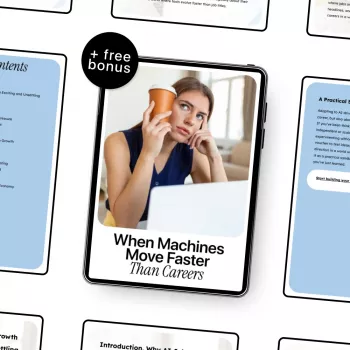
If you want a structured way to turn these into a repeatable system, the digital guide When Machines Move Faster Than Careers | Practical Guide to Navigating AI Job Growth Risks & Future‑Proof Skills is designed to help you audit tasks, build a skill stack, and document proof of work.
For long upskilling days, comfort and recovery still matter. If you’re rebuilding routines—more walking meetings, commuting, or standing work—consider supportive everyday gear like Nike Women’s Fuchsia Slip-On Lace-Up Sneakers. For downtime between learning blocks, a simple reset can help you stay consistent, like the Adorable Capybara Plush Pillow.
Jobs with a high share of repetitive, rules-based, text/data-heavy tasks are exposed sooner, especially when inputs are standardized (tickets, emails, spreadsheets). Often the role changes first as parts of the job are automated, so a task inventory plus stronger verification and domain judgment is a practical starting point.
Problem framing, domain depth, stakeholder influence, quality control, data literacy, and governance basics remain durable because they’re tied to accountability and real-world constraints. Pair tool use with measurement—define success metrics and prove outcomes over time.
Use a 30–60–90 day approach: improve one workflow, learn one tool category deeply, build a measurable portfolio artifact, then lead a small change initiative. Keep it going with a monthly learning loop and quarterly projects that increase responsibility and decision ownership.






Leave a comment