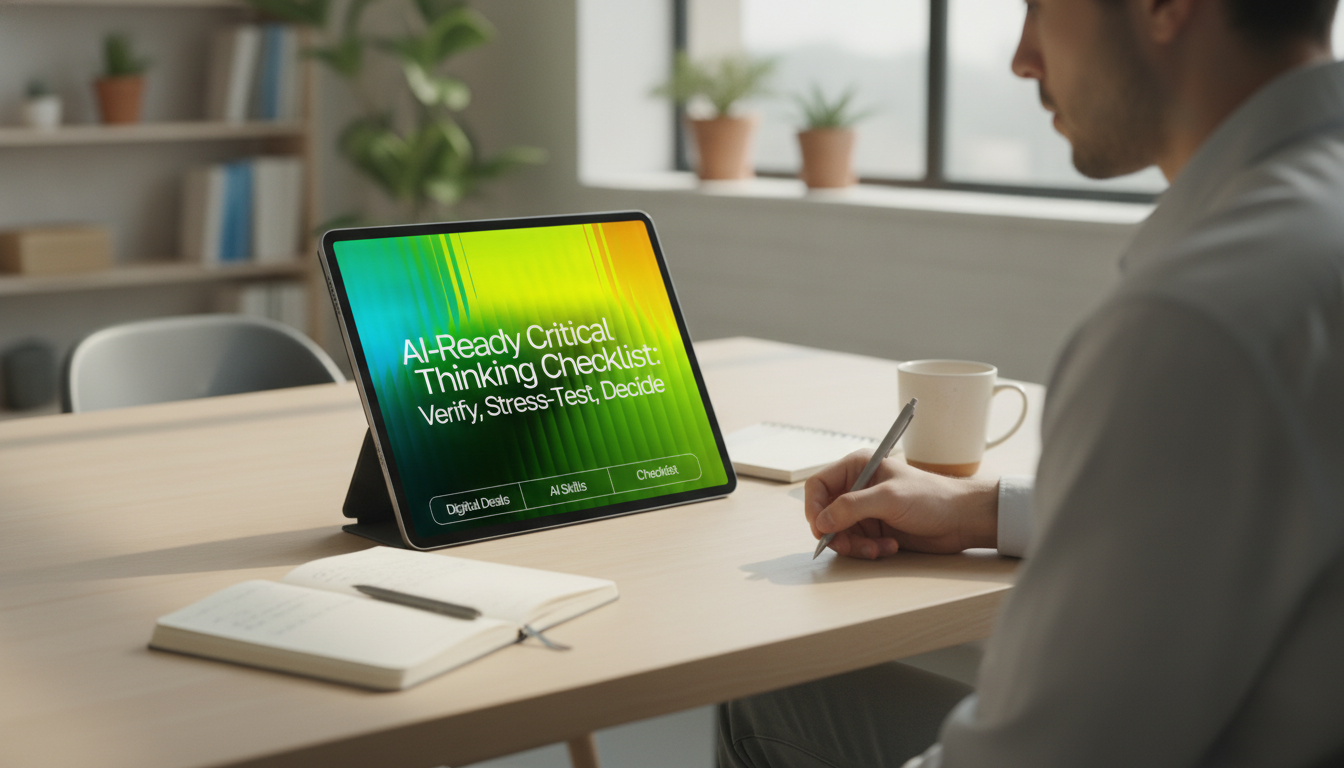
AI can accelerate research and drafting, but it can also amplify weak assumptions, missing context, and confident-sounding errors. A structured checklist makes it easier to slow down at the right moments, verify what matters, and turn AI output into dependable decisions—whether the task is writing, planning, analyzing, or problem-solving.
AI-ready critical thinking is less about “catching the AI” and more about building a repeatable way to evaluate any output—human or machine—before it becomes a decision. The goal is reliability: conclusions that can be explained, defended, and revised when new information appears.
Two helpful reference points for a more disciplined approach are the NIST AI Risk Management Framework (AI RMF 1.0) for thinking about AI-related risk, and the Stanford Encyclopedia of Philosophy entry on critical thinking for grounding what “good reasoning” actually requires.
Use the sequence below as a “decision funnel”: wide at the top (clarify what’s being asked), narrow at the bottom (commit to a conclusion with a paper trail).
Write the exact outcome needed, the constraints (budget, time, audience, tools), and what success looks like. If success can’t be described, the AI will fill the gap with guesswork.
List keywords that could be interpreted multiple ways and choose precise definitions. This prevents “agreement in words, disagreement in meaning.”
Identify what’s being taken for granted: data quality, audience needs, context, timelines, or what “normal conditions” are supposed to be.
Request a breakdown—claims → reasons → evidence—instead of a single narrative. Structure makes weak links visible.
Require citations or verifiable references and ask what the model is uncertain about. If it can’t name limits, you’ll discover them the hard way.
Generate at least 2–3 competing explanations or options and compare them. This directly reduces confirmation bias (see the APA definition of confirmation bias for why this matters).
Confirm key facts with reputable sources outside the AI output—especially numbers, legal requirements, health/safety claims, and timelines.
Look for leaps, circular logic, and unsupported generalizations. Ask the model to critique its own reasoning and to identify the weakest step.
Identify what could go wrong if the answer is wrong: cost, safety, fairness, reputation, compliance, or customer impact.
Record the chosen conclusion, why it was selected, and what evidence (or future signal) would change the decision. This turns “a good hunch” into a controllable process.
| Checkpoint | What to look for | Fast test |
|---|---|---|
| Clarity | The question and constraints are explicit | Can the task be summarized in one sentence without losing meaning? |
| Evidence | Claims are tied to sources or data | Which statements would still hold if citations were removed? |
| Completeness | Major counterpoints and edge cases are addressed | What’s the strongest objection—and is it answered? |
| Consistency | No contradictions across steps | Do definitions and numbers stay the same throughout? |
| Uncertainty | Limits and confidence are stated | What is unknown, and how would it change the outcome? |
If a reusable, printable format would make this process faster, the Step-by-Step AI Critical Thinking Checklist (digital download) organizes the full workflow into an easy scan: define the decision, clarify terms, surface assumptions, verify evidence, and stress-test logic. It’s designed for quick review before accepting AI-generated claims or recommendations, and it works alongside any AI tool because it focuses on evaluation habits rather than platform features. Price: $27.95 (digital download).
For another ready-to-use decision checklist (especially for time-sensitive purchases), the Shop Smart, Save Big This Prime Day | What to Buy on Amazon Prime Day Guide (digital download) is a practical companion for structured comparison, budget boundaries, and avoiding impulse-buy reasoning when deals create pressure.
Even outside “serious” tasks, disciplined evaluation helps with everyday choices. For example, when comparing items like Nike Women’s Fuchsia Slip-On Lace-Up Sneakers versus alternatives, the same steps—define the use case, clarify constraints (fit, return policy, surface type), test assumptions, and compare options—lead to fewer regrets and better long-term value.
Yes. The steps are tool-agnostic because they focus on evaluating claims, evidence, assumptions, and uncertainty—regardless of which platform generated the output.
For low-stakes tasks, 2–5 minutes is often enough for a quick pass. For high-stakes decisions, expect a longer second pass focused on verification, counterexamples, and risk.
Fact-checking verifies accuracy of statements. Critical thinking also tests the logic connecting claims to conclusions, checks framing and completeness, weighs tradeoffs, and evaluates what happens if the decision is wrong.






Leave a comment