
A strong AI-focused LinkedIn presence helps recruiters and collaborators quickly understand what you’ve built, what tools you used, and what outcomes you can deliver. The most effective profiles follow a repeatable system built on three pillars: positioning (what you do and for whom), proof (what you’ve shipped and measured), and presence (how consistently you show up and stay credible). Use the steps below to make quick, high-impact updates without turning your profile into a buzzword list.
“AI skills” on LinkedIn aren’t proven by listing tools—anyone can type “LLMs” into a Skills section. They’re proven when your profile makes it easy to see clarity, credibility, relevance, consistency, and approachability.
| LinkedIn section | What to add | Examples of proof |
|---|---|---|
| Headline | Role + niche + impact | “ML Engineer | LLM apps for customer support | Reduced handle time 18%” |
| About | Problem types solved + methods + constraints handled | Latency, privacy, evaluation, deployment, monitoring |
| Featured | Best work samples | Demo link, GitHub repo, case study PDF, talk recording |
| Experience | Bullets focused on outcomes and ownership | Model lift, cost reduction, automation hours saved |
| Skills/Endorsements | Curated list aligned to target roles | Prompt engineering, vector search, RAG, MLOps, A/B testing |
| Recommendations | Third-party validation | Manager/client note naming measurable impact |
Your top card (photo, banner, headline, location, and About preview) is your “scan test.” If it’s vague, the viewer has to work too hard to understand your value—so they move on.
Stick to: role + specialization + outcome. A headline packed with buzzwords (“AI | ML | LLM | NLP | GenAI”) rarely converts because it doesn’t anchor to a business problem or domain.
For LinkedIn-specific settings and profile controls, reference the LinkedIn Help Center to confirm the latest options and visibility behavior.
Experience bullets are where AI professionals often undersell themselves by describing tasks instead of ownership, constraints, and results. A strong bullet reads like a mini delivery story: what you owned, what you measured, and why it mattered.
| Before | After |
|---|---|
| Worked on chatbots using LLMs | Built a RAG support assistant with citation grounding; reduced escalations by 14% and improved CSAT by 0.3 points; implemented evaluation set + hallucination checks. |
| Did data science and automation | Automated weekly reporting pipeline; cut analyst hours by 10 hrs/week; added data quality tests and monitoring alerts. |
| Created ML models | Deployed churn model with drift monitoring; improved retention targeting ROI by 9%; partnered with marketing on A/B test rollout. |
For perspective on AI-adjacent role growth and market context, the U.S. Bureau of Labor Statistics page for Data Scientists is a helpful baseline reference.
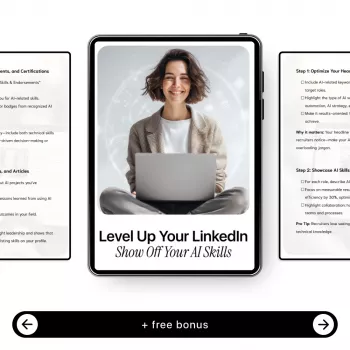
If you want a step-by-step path you can apply section-by-section, the Level Up Your LinkedIn: Show Off Your AI Skills – Digital Guide, eBook & Checklist is built for quick iteration: implement, publish, and refine based on the roles you’re targeting. It’s especially useful for AI engineers, data scientists, AI product managers, automation builders, and career switchers who need to translate technical work into outcomes.
For a second AI-forward digital resource that fits a “show what you built” mindset (especially if you’ve created practical AI workflows), consider Find Perfect Kid-Friendly Destinations with AI | Digital Family Travel Guide, which demonstrates structured AI-assisted planning and decision-making in a real-world context.
Use sanitized case studies: describe the problem, constraints, approach, evaluation method, and measurable outcomes in ranges. Leave out client names, sensitive data, and proprietary details, and consider adding diagrams or a comparable open-source demo.
Include role + specialization + outcome. Keep it specific to the roles you want (like LLM apps, MLOps, or analytics automation) and add a measurable or business-relevant result when possible.
Pick a sustainable cadence, such as 1–2 times per week, and prioritize high-signal posts like lessons learned, evaluation insights, small demos, and practical takeaways. Consistency matters more than volume.






Leave a comment