AI can draft fast, but it often misses the subtle signals that make a message feel trustworthy, human, and on-brand. A repeatable tone method helps turn “pretty good” drafts into writing that fits the moment—whether it’s a landing page, email sequence, social caption, or help article—without sounding generic or inconsistent. The goal isn’t to sound fancy; it’s to sound appropriately human, consistently, wherever customers meet your words.
Tone isn’t just word choice. It’s audience awareness, intent, and emotional temperature. When that layer is missing, readers feel it—even if they can’t name it.
If you want a deeper foundation on how tone shapes user trust and comprehension, Nielsen Norman Group’s guidance on tone of voice in writing is a solid reference point.
Before generating or editing a draft, lock in a short “tone brief.” This prevents the draft from drifting and gives every revision pass a clear target.
This tiny step makes everything downstream faster: fewer revisions, fewer “something feels off” comments, and fewer last-minute tone swings right before publishing.
Think of tone like a mixing board. You don’t need to reinvent your voice each time—you just adjust a few dials for the channel and the reader’s mindset.
Choose supportive vs. neutral vs. brisk. Warmth shows up in greetings, reassurance, and empathy statements. A calm “You’re not alone—this is common” can reduce friction in support content, while a brisk “Here’s the fastest fix” works for rushed readers.
Decide whether the writing should sound evidence-based and certain, or exploratory and open-ended. Tighten claims and add support where needed. Grammarly’s overview of tone in writing is helpful for spotting when wording undercuts credibility.
Reduce hedges and filler. Move the main point earlier. Prefer clear verbs and shorter sentences when urgency is high (checkout pages, troubleshooting), and use slightly softer phrasing when reassurance matters (FAQs, onboarding).
Replace generic benefits with concrete outcomes, limits, and examples. “Save time” becomes “cut your revision pass from three rounds to one.” “Improve engagement” becomes “increase replies” or “reduce confusion.”
Create guardrails: banned phrases, preferred verbs, preferred sentence length, and preferred formatting (bullets, headings, short paragraphs). These boundaries keep multiple writers—and multiple tools—sounding like one brand.
Match tone to context: the same offer needs different language in an email, a product page, and a support reply. Keep a consistent “tone baseline” across channels, then adjust intensity (energy, urgency, formality) for the moment. Keep claims consistent; change framing, not facts.
| Channel | Best default tone | What to avoid | Fast polish move |
|---|---|---|---|
| Landing page | Confident, clear, benefit-led | Hype without proof, vague outcomes | Replace adjectives with specifics and add one concrete example |
| Email newsletter | Friendly professional, conversational | Overly formal openings, long blocks | Shorten paragraphs; add a single clear next step |
| Social caption | Human, punchy, relatable | Corporate phrasing, too many hashtags/CTAs | Lead with a hook, then one takeaway and one action |
| Sales page FAQ | Reassuring, straightforward | Defensive tone, evasive answers | Answer in the first sentence; add a simple boundary/condition |
| Support/help article | Calm, precise, step-by-step | Blame, sarcasm, assumptions | Use numbered steps; confirm expected result after each step |
This workflow pairs well with a “people-first” standard: prioritize clarity, transparency, and helpfulness over showy language. Google Search Central’s guidance on helpful, reliable, people-first content maps well to credibility-driven tone choices.
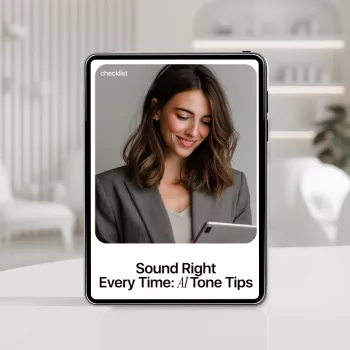
Sound Right Every Time: AI Tone Tips – Digital Writing Guide, AI Content Checklist, eBook for Creators & Marketers is built for creators and marketers who use AI but don’t want generic output. It includes practical tone guidance you can apply quickly when switching between channels, plus a checklist-style system to standardize voice across campaigns and platforms.
If your workflow already relies on checklists, you may also like other digital formats built for repeatable use, such as Delegating Meal Planning to Kids | Printable Family Guide, eBook & Checklist. And for a non-work reset that still supports creative momentum, Easter Themed Art Coloring Book for Adults & Teens is a simple way to step away and come back with fresher eyes.
Yes. Use the tone brief and checklist as a revision pass to align voice, adjust formality, and remove generic phrasing without rewriting from scratch.
Yes. Apply one baseline tone, then make channel-specific adjustments for energy, directness, and structure while keeping claims consistent from platform to platform.
Creators and marketers who draft with AI (or edit AI drafts) and need consistent, audience-appropriate tone across multiple assets benefit most.





Leave a comment