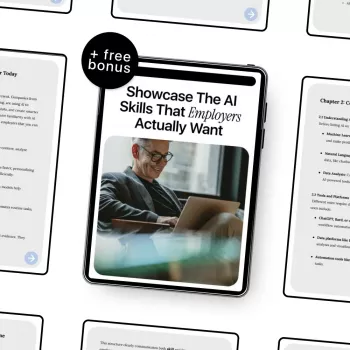
Most hiring teams aren’t looking for a list of tools—they’re looking for evidence that you can use AI to improve outcomes without creating new risks. In practice, “AI skills” usually means applied ability: you can frame the problem clearly, choose an appropriate workflow, document what you did, and deliver faster research, clearer analysis, safer processes, or measurable business impact.
Employers tend to value judgment and proof over brand-name tool lists. “Used ChatGPT” (or any model) isn’t a skill by itself; what matters is the workflow you designed, the constraints you followed (privacy, accuracy, tone, compliance), and the result you can defend. AI skills also vary by role: a marketer may focus on content QA and experimentation, while an analyst may focus on data cleaning, summarization, and evaluation.
Strong candidates translate a vague request (“improve onboarding emails”) into clear inputs, outputs, success criteria, and constraints that an AI-assisted workflow can support. This includes defining what “good” looks like and what failure looks like.
Employers want people who can write precise, testable instructions, iterate based on results, and build reusable templates that make quality repeatable. The deliverable is often a prompt kit or an SOP, not a single chat session.
Even non-technical roles benefit from knowing how data is sourced, cleaned, labeled, and protected. Hiring teams respond well to candidates who can explain what “good data” looks like for the task and where errors typically creep in.
Quality control is where “AI experience” becomes credible. This includes acceptance criteria, factuality checks, bias review, edge-case testing, and consistency checks—plus a plan for human review when stakes are higher.
Reducing manual work is a common win. Employers like to see spreadsheets, no-code tools, lightweight scripts, or APIs used to connect steps into a reliable pipeline—along with error handling and sampling checks.
AI-assisted work only helps if stakeholders trust it. Being able to explain what the system can and can’t do, how confident you are, and what reviewers should look for is a differentiator.
Risk awareness is no longer optional. Familiarity with responsible AI principles and guardrails—especially around sensitive data and fairness—helps reassure hiring teams. Useful references include the OECD AI Principles, the NIST AI Risk Management Framework (AI RMF 1.0), and the EEOC guidance on AI and algorithmic fairness.
A simple formula makes AI work scan well and sound believable: action + AI method/workflow + scope + measurable outcome. When possible, include baseline numbers (before/after), the artifact you built, and any guardrails (privacy steps, red-teaming, review workflow).
| Vague statement | Stronger resume bullet |
|---|---|
| Used AI to help with reports | Built an AI-assisted reporting workflow (prompt template + fact-check checklist) that cut weekly report drafting time 40% while improving consistency across 6 stakeholder versions |
| Experienced with ChatGPT | Created and maintained a prompt library for customer email responses with QA rubric; improved first-draft accuracy and reduced edit cycles from 3 to 1 on average |
| Did automation with AI | Automated lead enrichment using spreadsheet formulas + AI extraction; increased processed records/day from 120 to 300 with spot-check sampling to control error rate |
| Analyzed data using AI tools | Used AI-assisted clustering and summary workflows to surface 5 recurring churn drivers; partnered with CS to implement fixes that reduced monthly churn by 1.2 pts |
Applied workflows matter most: problem framing, reusable prompt templates, evaluation/QA, lightweight automation, and clear communication of limitations. Tie each skill to measurable outcomes like time saved, error reduction, throughput, or improved decision quality.
Describe your guardrails and review steps (fact-checking, citations where appropriate, approvals, sampling checks) and label work as “AI-assisted” when that’s accurate. Emphasize your judgment, editing, and accountability for the final output.
Use redacted or synthetic examples and publish small, concrete artifacts like a prompt kit with a rubric, a short evaluation comparison report, or an automation demo using sample data. Document assumptions and limitations so the proof feels professional and trustworthy.





Leave a comment